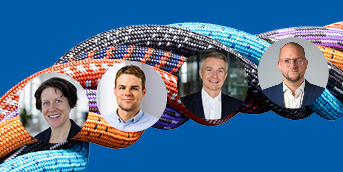
How the megatrend of “digitalisation and AI” impacts society depends not least on large corporations and how they deal with it. A panel of internal experts discusses their views on ethical responsibility, tight time slots and ideal scenarios in the interaction between humans and machines.
Angelika Gottweis (Group Data & AI), Florian Polt (Group Security & Resilience), Andreas Wimmer (Corporate Business Financial Lines) and Juri Reich (In-house Consulting) all agree that the next three or four years will bring rapid change. Also for the better. Work could become more exciting, systems could become more secure and quality could be improved. Provided there is a willingness to shape the future.
Megatrends are drivers of change, as our worldview suggests, but who drives the megatrends and do we have any influence over them?
Juri: No, we cannot influence the megatrends themselves; we simply have to adapt to things like digitalisation or climate change. But we can influence the consequences of megatrends; there is a strong behavioural component here. As an insurance company, we have a mediating role .
Angelika: As a company, we have significant leverage because we decide how we use new technologies – that should not be underestimated. We are a key player in building trust. Our approach to AI can both reinforce and dispel a mistrustful attitude in society.
Florian: We also have leverage on the business side; cyber underwriting has achieved more in recent years than any regulation.
By telling customers, ‘You must take security measures, then the risk becomes insurable’?
Andreas: Yes, this approach has generally worked; the corporate customer must also recognise their own risk – but it often leads to detailed technical discussions that put many customers off. That is why we have deliberately chosen an additional approach: for clearly defined risks up to a certain scale, we avoid extensive risk questionnaires in order to better reach customers.
At the same time, this does not mean that we take on risks without control. We work with risk scans and standardised underwriting criteria, and use this model to systematically gather empirical data – and we are appropriately covered and protected.
We are experiencing this increased interaction between humans and machines in two ways: because the risks affect us personally, and because we are protecting others from these risks. How will this interaction shape our future? What are the parallels, and what are the differences compared to the Industrial Revolution of the 19th century?
Juri: The role of human labour is changing. Unlike during the Industrial Revolution, participation is much greater today; the change is democratised. Back then, it was primarily the working class that was affected; today it is the middle class, the knowledge workers. But above all, we have very different forms of state protection today than we did back then. Perhaps the role, distribution and remuneration of work need to be rethought in society.
Florian: For me, the big difference is the adjustment period; back then it was over 50 years, today we have three or four years. And that does worry me, as a father; our school system is lagging far behind.
Angelika: In addition to the differences already mentioned, there is also a significant difference in economic logic: during the Industrial Revolution, machines were only widely deployed once they were cheaper and more efficient than human labour. With AI, however, that is often not yet the case today. The use of AI is currently being heavily hyped, but the economic benefits have so far often been limited. I also find it fascinating that, just a few years ago, the prevailing view was that it was mainly manual jobs and tasks that would be threatened by the use of robots. Today, we see that AI affects everyone, particularly creative professions and those requiring cognitive skills. Fundamental changes are therefore on the horizon, even if the scale of job losses is perhaps being overestimated. I see the real challenge rather in the fact that parts of the population are not being sufficiently included in this development – and it is precisely this fear that some are deliberately exploiting.
When we talk about fear, we’re talking about power – will power and responsibility ultimately be handed over to artificial intelligence?
Florian: My core argument is that responsibility can be delegated legally, but not ethically. We talk about ‘human-in-the-loop’; I prefer ‘human-in-the-lead’.
Angelika: The EU’s regulatory framework, particularly the EU AI Act, is ultimately based on our European values and our fundamental rights, and places obligations on companies. It thus sets a clear baseline: certain AI applications are incompatible with these values, e.g. social scoring, as we know it from China, for instance. At the same time, it is evident in practice that many of our specific use cases – including those at UNIQA – are subject to little or no regulation. However, this does not mean that there is no risk here – on the contrary: we must manage this area on our own responsibility – through active and targeted AI governance. The liability and reputational risk, and thus the responsibility, remain with UNIQA. We cannot outsource that to AI.
What challenges does this pose when it comes to customer engagement?
Angelika: I think that, for the time being at least, we should continue to offer parallel options in customer communication: there are already customers today who prefer to take out insurance entirely online or handle a claim digitally. At the same time, a great many people still expect and value personal contact and want to speak to a human being.
Andreas: We enable a personalised approach; the customer decides. At the same time, we’re already seeing AI apps that are putting pressure on brokers here and there when it comes to advice. It’s even conceivable that AI solutions might one day set up an insurance company themselves and cover the risks from their own pool!
Florian: But we’ve seen the digital transformation before; what Google was, ChatGPT is now – this shift is going to happen; people are now asking AI. We need to position ourselves in such a way that we create organisational resilience: no matter where the customer makes an enquiry, they receive a response of the same quality.
Angelika: If someone contacts us today, they might not receive the same information everywhere. Perhaps through effective digitalisation – because that’s what it’s all about, it’s not just about AI – we can improve the quality of service for our customers. Employees, applicants and customers – everyone must benefit from new technologies.